Manila Philippines – The Supreme Court of the Philippines has dismissed a petition seeking to compel the Senate to convene as an impeachment court for the trial of Vice President Sara Duterte. The decision, issued on April 29, 2026, was penned by Associate Justice Rodil V. Zalameda and supported by a 14-0-1 vote.
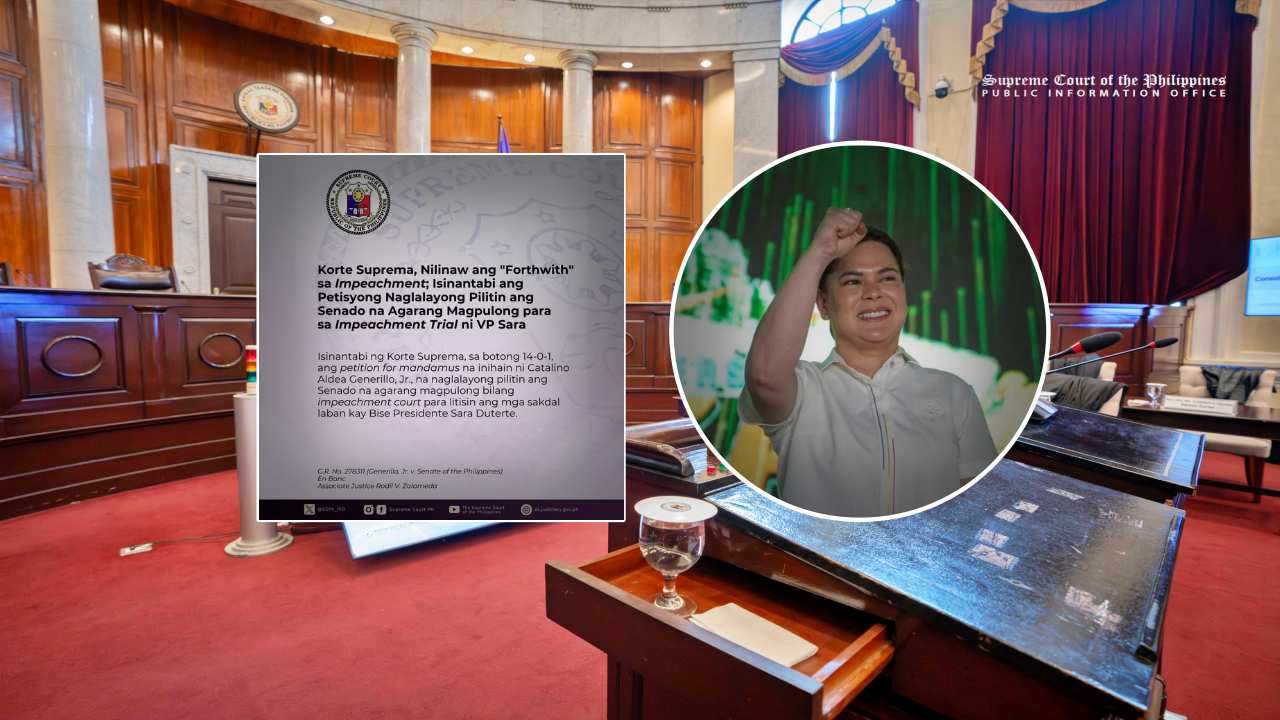
Petition for Mandamus Declared Improper
According to a press briefer from the Supreme Court, the petition for mandamus filed by Catalino Aldea Generillo, Jr. was deemed an improper remedy. The Court emphasized that mandamus is only applicable to enforce a clear legal duty, which was not present in this case. The Senate, as a co-equal constitutional body, operates independently and cannot be compelled by the judiciary unless there is grave abuse of discretion.
Petition Treated as Certiorari
In the interest of equity, the Supreme Court treated the petition as one for certiorari to determine whether the Senate acted unlawfully or abused its discretion. The Court found that the Senate acted within a reasonable timeframe and clarified that the Constitution does not mandate a specific period for the Senate to convene as an impeachment court. The term “forthwith” in the Constitution was interpreted to mean “within a reasonable time,” allowing the Senate to make necessary preparations.
Mootness of the Case
The Court declared the petition moot, as the Senate had already begun preparations for the impeachment trial. Additionally, the Articles of Impeachment against Vice President Duterte were nullified by earlier Supreme Court rulings in 2025 and 2026. With no Articles of Impeachment remaining, there was no basis for the Senate to convene as an impeachment court.
Dissenting Opinion
Senior Associate Justice Marvic M.V.F. Leonen concurred with the dismissal but expressed that the impeachment court should have been convened immediately. He argued that the impeachment court, not just the Senate President, should have taken charge of organizing the trial.
This decision underscores the independence of constitutional bodies and the judiciary’s limited role in intervening in legislative processes. For more details, the full text of the decision will be made available on the Supreme Court’s official website.